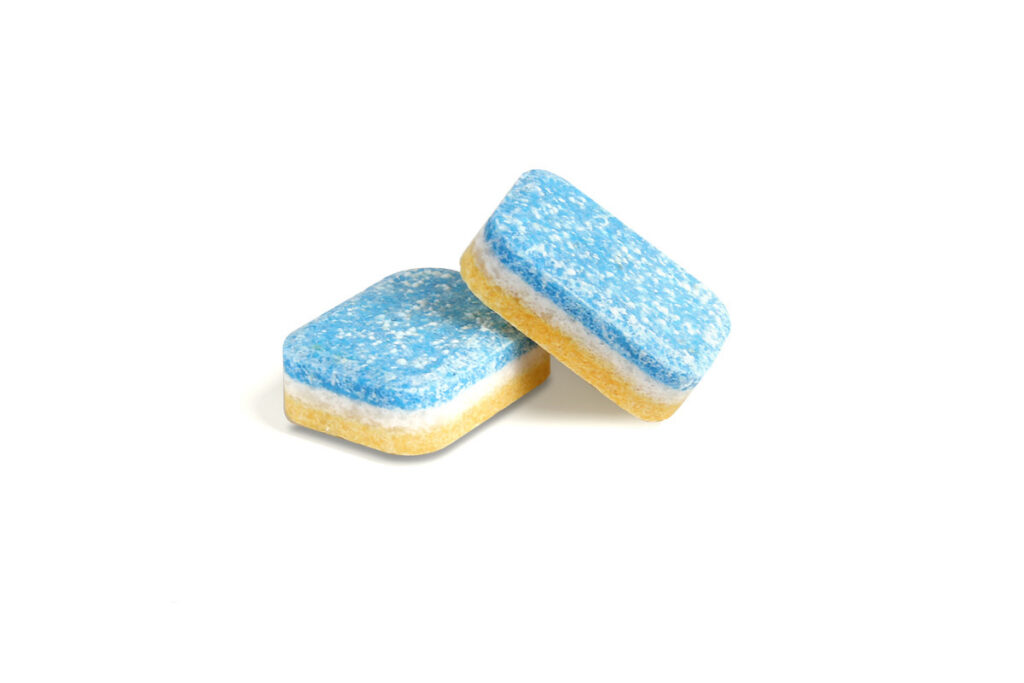
Private label dishwasher tablets are tablets made by a manufacturer to a brand owner’s specification and sold under the brand owner’s name. A typical project runs through seven stages: brief, formula selection, samples, local testing, artwork and compliance, pre-production approval, and production with quality control. Most delays come from artwork and labelling rather than from the factory, so the fastest projects are the ones where the buyer has decided the format, the claims and the target market before the first sample is made.
This guide is written for retailers, distributors, Amazon sellers and new brands who want their own dishwasher tablet range. It explains what you need to decide at each step and what you should ask the factory. It is not a substitute for the regulatory advice of your own compliance team.
Is private label the right route for you?
Private label makes sense when you want control over the brand, the price position and the packaging, but do not want to build a pressing line yourself. It is less suitable if you only need a few cartons for a trial: every private label run carries fixed costs for printed packaging, label checks and production set-up, and those costs are spread over the order quantity.
- Good fit: supermarket and discounter own brands, regional distributors, online brands with a clear target market, hospitality suppliers who want a branded consumable.
- Poor fit: one-off promotional orders, buyers who have not yet chosen a market (labelling rules differ), or projects that need a claim no laboratory has tested yet.
Step 1: Write a short brief
A one-page brief saves more time than any other document. It should answer:
- Target country or countries, and the language(s) on the pack.
- Price position: entry, mid-range or premium. This drives the number of functions and the tablet weight.
- Format: single-layer pressed tablet, multi-layer tablet, or tablet wrapped in water-soluble film.
- Functions you want to claim, for example cleaning, rinse aid, salt function, glass protection.
- Pack format: stand-up pouch, carton box, tub, or bulk packaging for hospitality.
- Expected order volume for the first order and for a year.
Step 2: Choose the formula and the format
Most dishwasher tablets combine the same families of ingredients: builders that soften water and hold dirt in suspension, an alkali source, an oxygen bleach for tea and coffee stains, enzymes for protein and starch, a low-foaming surfactant, and sometimes a rinse-aid component. What differs between products is the balance between them and the tablet weight.
| Decision | Option A | Option B | What to consider |
|---|---|---|---|
| Layers | Single layer | Two or three layers | Layers let you separate ingredients and show functions visually; they add pressing complexity. |
| Wrapping | Individually wrapped in foil or film that is removed by hand | Water-soluble (PVA) film that goes into the machine | Water-soluble film is more convenient for consumers; wrapped tablets are often simpler to produce. |
| Phosphates | Phosphate-based builders | Phosphate-free builders | The EU limits phosphorus in consumer automatic dishwasher detergents under Regulation (EU) No 259/2012, so EU projects are usually phosphate-free. |
| Fragrance and colour | Unscented, neutral | Scented, coloured layers | Every fragrance and dye must appear correctly in the ingredient and hazard information. |
Ask the factory which formulas it already produces at scale. A formula that is already running on the line is easier to sample, test and reorder than one developed from zero.
Step 3: Samples and testing in your own water
Ask for samples of the exact formula, weight and wrapping you plan to sell. Test them in the dishwasher models and water hardness common in your target market. Hard water and short eco programmes are where weak formulas show up first, with white film on glasses or tablets that do not fully dissolve.
Keep the test simple and repeatable: the same load, the same programme, the same soil (for example dried egg yolk and tea stains), and photographs of the results. If you plan to make a performance claim on the pack, discuss with your testing laboratory which method will support it before you write the claim.
Step 4: Artwork, labelling and documents
This is the stage that most often delays a launch. For the EU, the label of a dishwasher detergent normally has to meet the detergents rules (Regulation (EC) No 648/2004 and its revision) and the classification, labelling and packaging rules of the CLP Regulation (EC) No 1272/2008. In practice that means ingredient information, dosage instructions, hazard pictograms and statements where the mixture is classified, the supplier’s contact details, and child-safety warnings.
Ask the factory for:
- A Safety Data Sheet (SDS) for the exact formula, in the language of your market.
- The classification of the mixture, so your designer can place the right pictograms and statements.
- The ingredient list in the order and naming your label needs.
- Dimensions and dielines for the pouch, box or tub you have chosen.
The brand owner is usually responsible for what the label says in its market, so have your own compliance contact check the final artwork. A factory can prepare the data, but it cannot take legal responsibility for a market it does not sell into.
Step 5: Pre-production approval
Before mass production, approve three things in writing: the final formula and tablet weight, the printed packaging proof, and a pre-production sample packed in the real packaging. Keep one approved sample on your side and ask the factory to keep a matching retained sample. If there is ever a question about a later batch, both sides compare against the same reference.
Step 6: Production and quality control
During production, dishwasher tablets are mixed, pressed, then wrapped and packed. The checks that matter most to a buyer are:

- Tablet weight within the agreed tolerance, because weight drives both performance and the dose stated on the pack.
- Hardness and friability, so tablets do not crumble in transit but still dissolve in the machine.
- Dissolution in a short programme, especially for film-wrapped tablets.
- Seal integrity and moisture protection of the outer pack, because dishwasher tablets absorb moisture.
- Print and barcode checks on the finished packaging.
Ask which of these are checked on every batch and which are checked periodically, and request the batch records with your shipment.
Step 7: Packing, palletising and shipping
Agree the carton count, carton size and pallet pattern before production so the factory can plan materials. Dishwasher tablets should travel dry and away from heat. For sea freight, ask how cartons are protected against condensation in the container, and confirm with your forwarder which transport documents your formula needs.
What drives MOQ, cost and lead time
There is no single minimum order for private label dishwasher tablets. The minimum is usually set by the packaging, not by the tablets: printed pouches and boxes have their own minimum runs at the packaging supplier. Cost depends mainly on tablet weight, the number of functions, the wrapping, the pack format and the order quantity. Lead time depends on whether the formula and packaging are new or repeat. Ask for these three numbers in the same quotation so you can compare factories fairly.
Checklist: what to send with your enquiry
- Target market and pack language.
- Format: layers, wrapping, tablet weight if you already have one in mind.
- Functions and any claims you want on the pack.
- Pack type and count per pack.
- First order quantity and estimated yearly volume.
- Whether you already have artwork, or need the dielines first.
Oradess manufactures dishwasher tablets and other household cleaning tablets for private label customers, and has done so since 2019. If you are planning a range, send us your brief with the points above and we will reply with the formula options, sample plan and current MOQ for your pack format. For consumer-side questions about residue and dissolving, see our article Will Dishwasher Tablets Leave Residue in the Dishwasher?