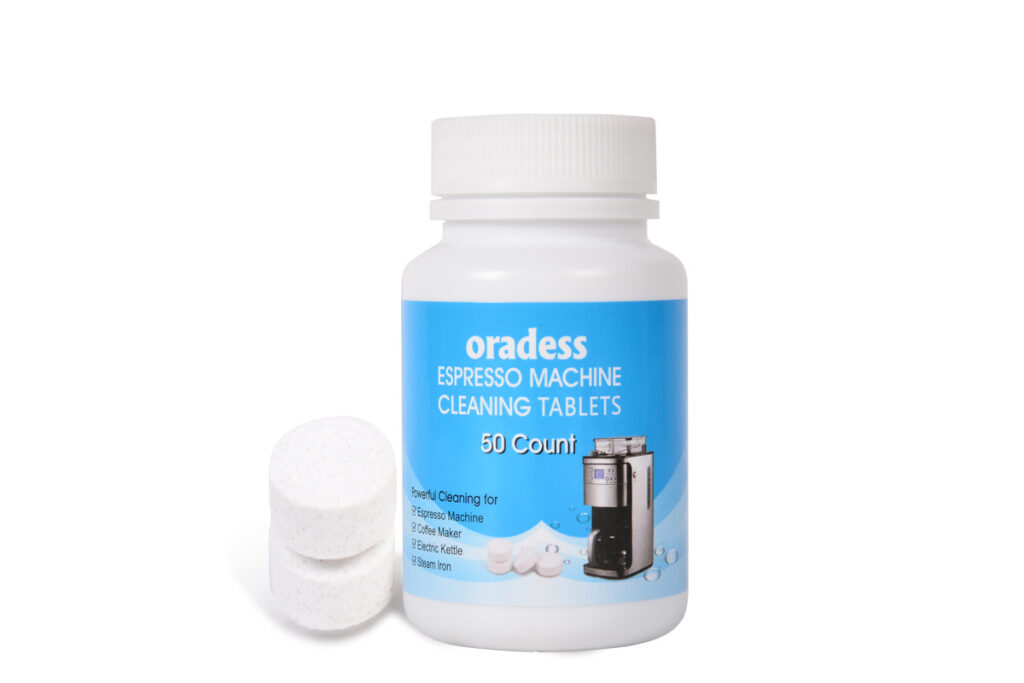
To use espresso machine cleaning tablets on a machine with a portafilter, put a blind (solid) basket in the portafilter, drop one tablet into it, lock it in, and run short on-off brew cycles so the cleaning solution is forced back through the group head. Then rinse with several cycles of clean water and pull one shot to throw away. On a fully automatic machine, do not improvise: start the machine’s own cleaning programme and add the tablet only when the display asks for it.
The steps below cover both cases. Always check your machine’s manual first. Some machines, especially those without a three-way solenoid valve, must not be backflushed at all.
What a cleaning tablet does (and what it does not)
Every shot leaves coffee oils behind in the group head, the shower screen and the portafilter. Over days these oils turn rancid and make coffee taste bitter and flat. A cleaning tablet dissolves into an alkaline cleaning solution that breaks those oils down so they can be rinsed away.
A cleaning tablet does not remove limescale. Scale is a mineral deposit from hard water inside the boiler and pipes, and it needs an acidic descaler. If you are not sure which one your machine needs, read Espresso Cleaning Tablets vs Descaling Tablets.
Before you start: check three things
- Does your machine allow backflushing? Machines with a three-way solenoid valve (common on E61-style and commercial machines) release pressure into the drip tray and can be backflushed. Many entry-level machines cannot. The manual will say.
- Do you have a blind basket? It is a filter basket with no holes. A rubber backflush disc that sits in a normal basket also works.
- Is the tablet the right size? Tablets for portafilter machines and tablets for fully automatic machines are often different in size and dose. Use the one recommended for your machine type.
How to clean a portafilter (semi-automatic) machine, step by step
- Warm the machine up to normal brewing temperature. Cleaning works better hot.
- Remove the normal basket and fit the blind basket in the portafilter.
- Place one tablet in the blind basket. For a single-group machine one tablet per cleaning is the usual dose; follow the tablet pack if it says otherwise.
- Lock the portafilter into the group head.
- Run the pump for about 10 seconds, then stop for about 10 seconds. When you stop, pressure releases and the solution flows back through the group and out into the drip tray. Repeat this on-off cycle five to ten times.
- Remove the portafilter and check the solution. Brown, foamy water means oils are coming out. If it is very dark, repeat the cycles with a fresh tablet.
- Rinse the blind basket and repeat the on-off cycles with clean water only, at least five to ten times, until the water running into the drip tray is clear.
- Clean the parts you can reach. Wipe the group gasket and shower screen with a group brush. Soak the portafilter and normal baskets (without plastic or wooden handles) in a cup of hot water with a dissolved tablet if they are greasy, then rinse thoroughly.
- Refit the normal basket and pull one shot. Throw it away. This removes any remaining taste of cleaner.
For a two-group machine, repeat the process on each group. Never leave a tablet or cleaning solution in the group head and walk away.
How to clean a fully automatic (bean-to-cup) machine
Fully automatic machines have their own cleaning programme, and the brewing unit is enclosed. The general pattern is:

- Empty the drip tray and grounds container and fill the water tank.
- Start the cleaning programme from the menu.
- When prompted, drop one tablet into the ground-coffee chute (or the place your manual shows). Do not add ground coffee.
- Let the programme run to the end. It will rinse automatically.
- Empty the drip tray and grounds container again.
Use tablets that fit your machine’s chute. A tablet that is too large can jam the chute; one that is too small may not give a full cleaning dose.
How often should you use a cleaning tablet?
As a rule of thumb, backflush with water daily on a busy machine and with a cleaning tablet once a day to once a week, depending on how many shots you pull. A café that makes hundreds of drinks a day usually cleans with a tablet at the end of every day; a home user who makes two drinks a day may need it once every week or two. Fully automatic machines usually ask for a cleaning cycle after a set number of drinks. If your coffee starts tasting bitter or the shower screen looks brown, you are cleaning too rarely.
Common mistakes
| Mistake | What happens | Fix |
|---|---|---|
| Backflushing a machine without a three-way valve | Cleaning solution can be pushed into parts that cannot drain it | Check the manual; clean the shower screen and basket by hand instead |
| Skipping the clean-water rinse | Next coffee tastes soapy or chemical | Rinse until the water in the drip tray is clear, then discard one shot |
| Using a descaler instead of a cleaning tablet | Oils stay in the group; scale treatment is wasted | Use a cleaning tablet for oils and a descaler for limescale |
| Soaking parts with plastic or wooden handles | Handles and seals can be damaged | Soak only metal baskets and the metal part of the portafilter |
Safety
Cleaning tablets are concentrated cleaning products. Keep them in their pack, away from children, and do not handle them with wet hands. Read the warnings on the label and the Safety Data Sheet, and rinse the machine thoroughly before making coffee again. For more detail, see Understanding the Safety of Coffee Machine Cleaning Tablets.
Buying cleaning tablets for a café, distributor or own brand
Oradess makes espresso machine cleaning tablets and coffee machine cleaning tablets in bottles and blister packs, including private label versions. If you are a distributor or a coffee equipment brand, tell us which machine types your customers use, the pack format you want and your expected volume, and we will suggest the tablet size and pack that fit.