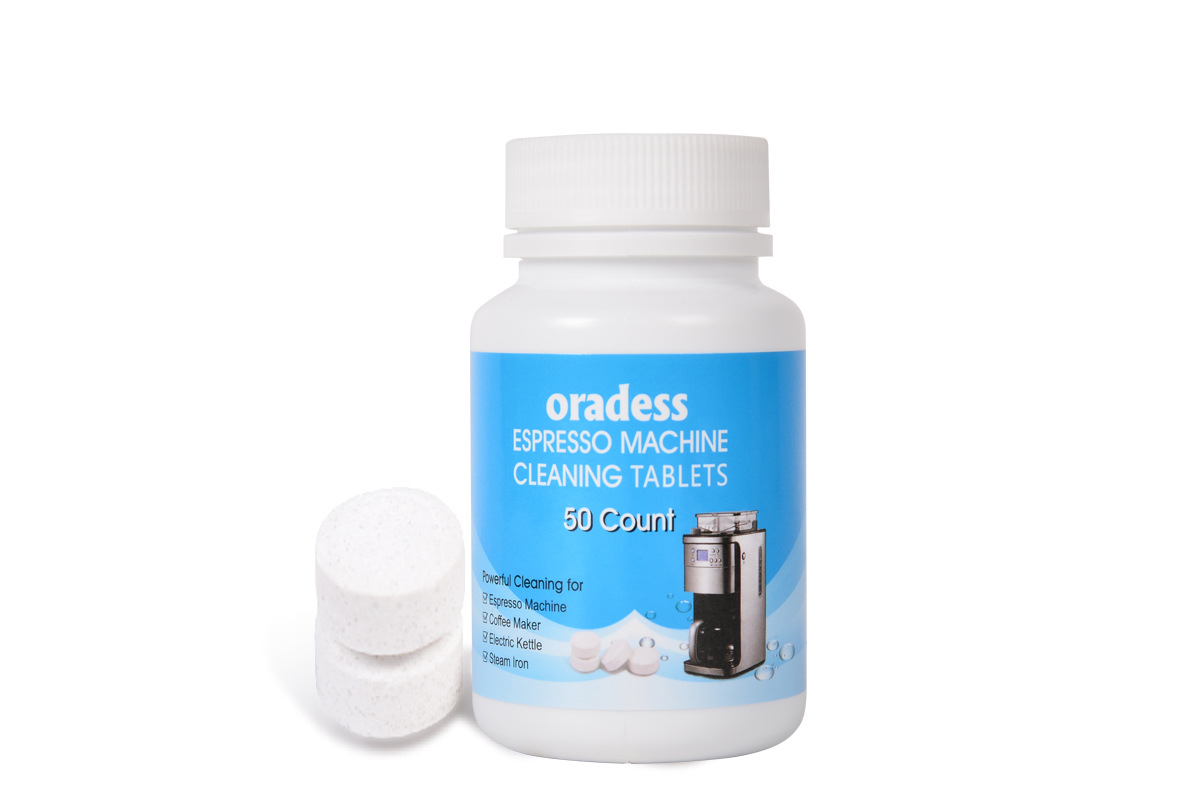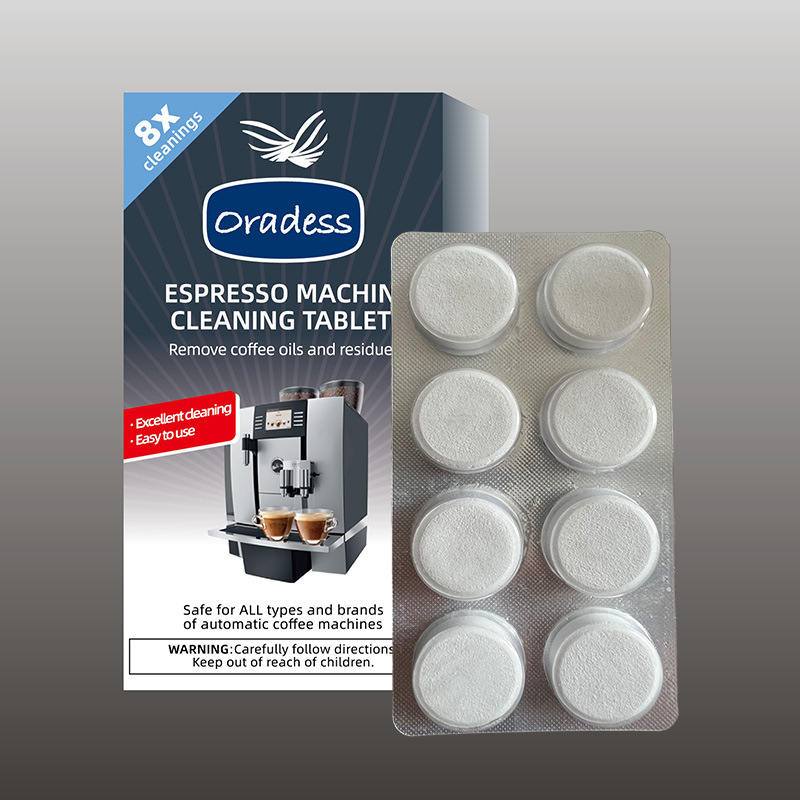
Espresso cleaning tablets and descaling tablets solve two different problems. Cleaning tablets are alkaline and remove coffee oils from the group head, shower screen and brewing unit. Descaling tablets or descalers are acidic and remove limescale, the mineral deposit hard water leaves inside the boiler, heating element and pipes. Most espresso machines need both, on different schedules. Using one in place of the other leaves the real problem untouched.
The quick answer
| Cleaning tablets | Descaling tablets / descaler | |
|---|---|---|
| Removes | Coffee oils, fats and brown coffee residue | Limescale (calcium and magnesium carbonate) |
| Chemistry | Alkaline, often with an oxygen-based cleaning agent | Acidic, typically citric, lactic or sulfamic acid |
| Where it works | The coffee path: group head, shower screen, portafilter, brewing unit | The water path: tank, boiler, heating element, pipes, valves |
| How it goes in | Blind basket (backflush) or the ground-coffee chute of an automatic machine | Dissolved in the water tank and run through the machine |
| Typical frequency | Daily to weekly, depending on shots pulled | Every one to three months, depending on water hardness and use |
| Sign you need it | Bitter, flat or rancid taste; brown shower screen | Slower flow, lower temperature, white crust, descale warning light |
Why coffee oils and limescale need different chemistry
Coffee oils are organic fats. Alkaline cleaners react with fats and make them soluble in water, so they rinse away. An acid does little to these oils.
Limescale is mineral. When hard water is heated, dissolved calcium and magnesium come out of solution and stick to hot surfaces. Acids dissolve this mineral layer. An alkaline cleaner does not.
That is why the two products are kept separate. Mixing them in the same cycle does not give you a two-in-one product: an acid and an alkali partly neutralise each other, so neither works as intended.
Where each one travels inside the machine
Think of an espresso machine as two circuits. The water path runs from the tank or mains supply through the pump, boiler or thermoblock, and valves. The coffee path starts where hot water meets coffee: the shower screen, group head and portafilter in a semi-automatic machine, or the brewing unit in a fully automatic one.

Limescale builds up along the water path, especially on hot surfaces. Coffee oils build up along the coffee path. A descaler has to be run through the water path to reach the scale; a cleaning tablet has to be placed where the coffee is brewed so its solution reaches the oils.
How to tell which problem you have
- Coffee tastes bitter, burnt or stale even with fresh beans → coffee oils. Use a cleaning tablet.
- The shower screen or brewing unit looks brown or greasy → coffee oils. Use a cleaning tablet.
- Water flows more slowly, the machine takes longer to heat, or drinks are not as hot → limescale. Descale.
- White chalky deposits around the steam wand tip or in the water tank → limescale. Descale.
- The machine shows a descale or cleaning warning → follow the instruction the machine gives; it counts water volume and drinks separately.
How often to use each
Cleaning frequency depends on how many coffees you make. A busy café usually backflushes with a cleaning tablet at the end of each day; a home machine might need it once every week or two. The step-by-step process is in How to Use Espresso Machine Cleaning Tablets.
Descaling frequency depends mainly on water hardness. In soft-water areas, or where a water filter or softener is used, descaling may be needed only a few times a year. In hard-water areas it may be monthly. Many fully automatic machines let you set the water hardness so they can remind you at the right time.
Can you descale a commercial espresso machine with tablets?
Home and office machines with a removable water tank are designed to be descaled by the user with a descaling product dissolved in the tank. Commercial machines plumbed into the mains usually rely on a water softener or filter to prevent scale, and descaling the boiler is normally a service job, because it involves the boiler, heating element and safety valves. If you run a café, ask your machine technician before descaling it yourself.
Safety and compatibility
- Use the product type your machine’s manufacturer recommends. Some descaling acids are not recommended for certain metals or seals.
- Never run a descaler through the group head with a coffee puck or cleaning tablet in it.
- After either process, rinse with clean water as the instructions say before making coffee again.
- Keep both products in their original pack and out of reach of children.
For retailers and coffee equipment brands
Because customers need both products, many shops and coffee equipment brands sell cleaning tablets and descaler side by side, or as a care kit. When you source them, make sure the pack clearly says which job each product does; confused customers often buy the wrong one and conclude it does not work.
Oradess manufactures espresso machine cleaning tablets and coffee machine cleaning tablets, including private label packs. Contact us with your machine types, pack format and expected volumes, and we will recommend tablet sizes and packaging. You can also read our overview of espresso machine cleaning tablets.